The problem: Bayes-Swarm gets slower exactly when it matters most
Bayes-Swarm is a batch Bayesian search algorithm this research group has used to drive collective search behavior in UAV swarms for signal source localization and hazard/search-and-rescue missions. It works by progressively building and refining a belief model — a Gaussian Process (GP) — of the signal environment from every observation robots have collected so far.
That belief model is also the bottleneck: as a mission runs longer, or the swarm grows larger, the dataset of collected observations keeps growing, and re-fitting the GP on an ever-larger dataset gets progressively more computationally expensive. For decentralized, onboard decision-making — where a robot needs to decide its next waypoint in real time, not after a long wait — that growing cost is a genuine scalability wall, not just a minor inefficiency.
The approach: teach a CNN to down-sample the right way
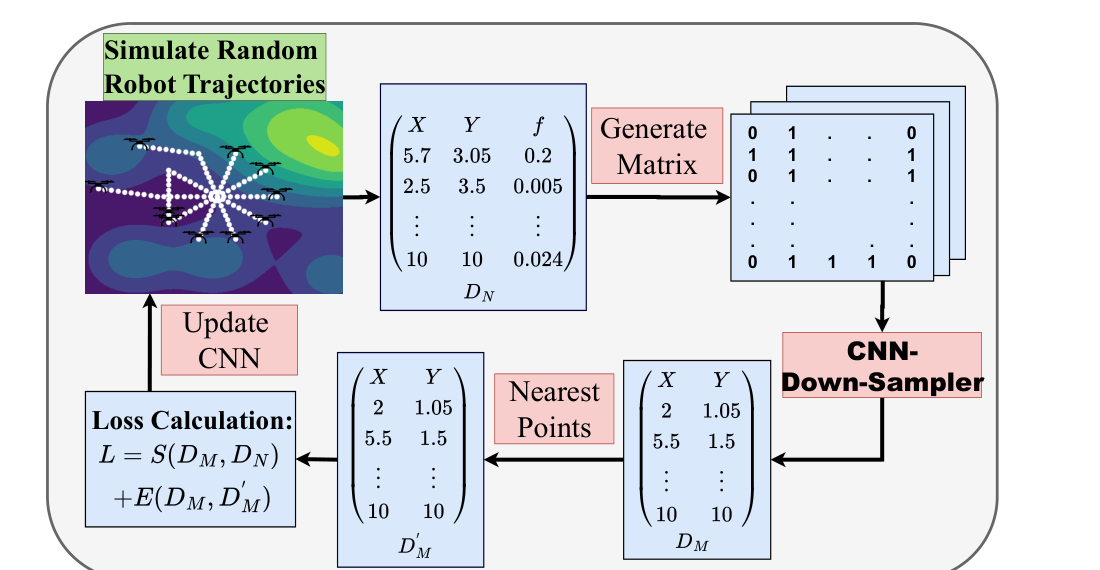
Rather than processing every observation directly, this paper trains a convolutional neural network (CNN) to down-sample the accumulated observation data before it feeds into Bayes-Swarm’s decision process. Three elements make this work:
- A new input/output abstraction — the visited locations and down-sampled data are projected onto a fixed-size pixel-like grid ([X], [Y] coordinate matrices plus a visitation-memory matrix [B]), so a CNN can read a growing, variable-size observation history as a standard-sized image-like input.
- A probabilistic loss function based on Sinkhorn distance — an efficiently-computable approximation of the Wasserstein distance — that measures how closely the down-sampled data’s spatial distribution matches the full dataset’s, combined with a nearest-neighbor error term that keeps down-sampled points close to real observed locations.
- The CNN itself, trained entirely on simulated random robot trajectories rather than expensive full swarm-search simulations — so training the down-sampler doesn’t require running the costly missions it’s meant to speed up.
The resulting system, CNN-Bayes-Swarm, feeds its down-sampled output through a nearest-neighbor step to snap selected points back onto real observed locations before they reach the GP.
Results: real-time on a Raspberry Pi, not just a workstation
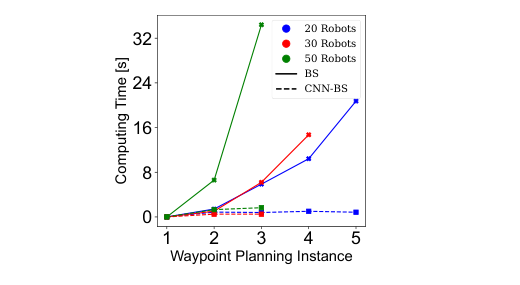
On a workstation, CNN-Bayes-Swarm’s compute time per waypoint decision stays essentially flat as swarm size grows from 20 to 50 robots, while the original Bayes-Swarm’s compute time climbs sharply — in a 50-robot mission, deciding a single waypoint takes about 30 seconds with original Bayes-Swarm versus roughly 1 second with CNN-Bayes-Swarm.
That gap matters even more on realistic onboard hardware: tested on a Raspberry Pi 4, CNN-Bayes-Swarm’s down-sampling compute time stays low and nearly flat as the incoming dataset grows from 1,000 to 50,000 points. A baseline RANSAC-based down-sampler, by contrast, grows by nearly 40x over the same range — attractive mission performance on paper, but impractical once real onboard compute time is counted.
Ablation studies confirm both design choices earn their place: a CNN-based down-sampler beats naive random and greedy down-sampling on mission completion time, and the combined Sinkhorn-plus-nearest-neighbor loss function outperforms training with either loss term alone.
Why this matters
A decentralized swarm search algorithm that gets slower the longer a mission runs, or the larger the swarm gets, is hard to trust for anything beyond short demonstrations on a workstation. This down-sampling approach is a direct, validated-on-real-hardware answer to that scalability ceiling — relevant not just to Bayes-Swarm specifically, but to the broader class of decentralized, belief-model-driven swarm decision-making methods that face the same growing-cost problem as missions get longer and swarms get larger.
- What is CNN-Bayes-Swarm?
- CNN-Bayes-Swarm is a version of the Bayes-Swarm decentralized search algorithm that uses a trained convolutional neural network to down-sample accumulated observation data in real time, keeping decision-making computationally scalable — including on onboard hardware like a Raspberry Pi — as a search mission progresses.