The problem: swarm behavior research mostly ignores hardware design
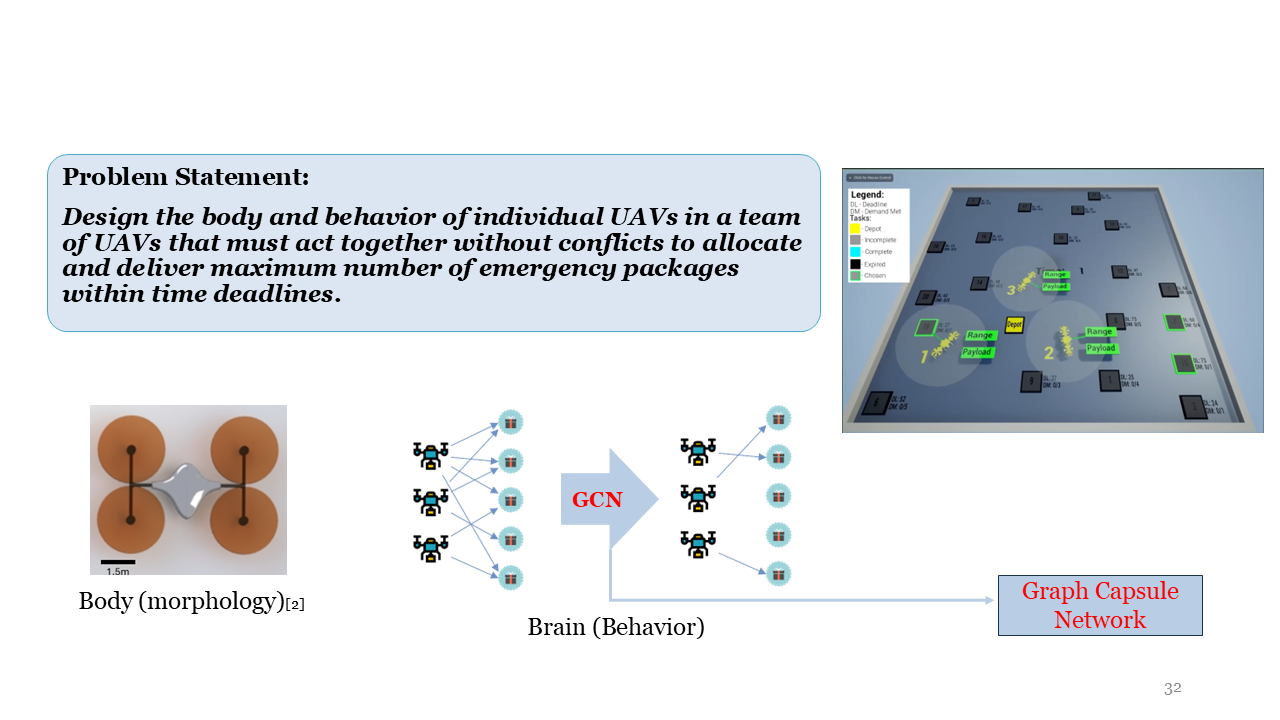
A team of unmanned aerial vehicles (UAVs) searching for a signal source — a survivor’s phone, a gas leak, a radio beacon — is only as good as the individual robots that make it up, and individual capability is set by morphology: sensor range, flight endurance, payload, speed. Yet outside a handful of ad hoc evolutionary-robotics studies, there’s been very little systematic work on how morphology and collective search behavior actually interact — and essentially no computational framework for searching robot morphology and behavior hyperparameters jointly, optimized for team-level performance rather than single-robot performance.
This is the same underlying challenge tackled from a task-allocation angle in this group’s later Talent-based co-design work — here applied specifically to collective search.
The approach: Talent metrics, four stages
The framework proposed here is built around the same core idea that later work extends: the “Talent” metric — a device that sidesteps the exploding computational cost of a fully nested morphology/behavior search, while still finding meaningfully better solutions than the standard “pick morphology first, then design behavior” sequence.
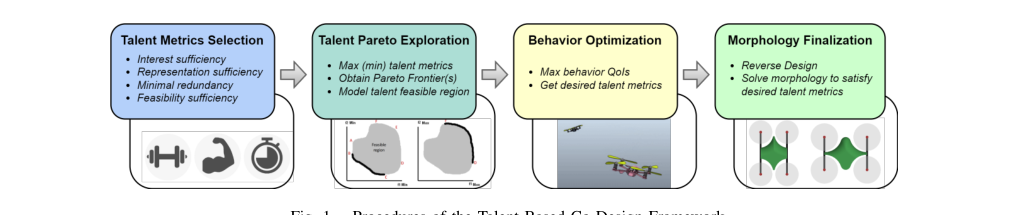
The pipeline runs in four stages:
- Talent metric selection — choosing which morphology-driven capabilities actually matter for the search task. Here: flight range, cruising speed, and sensor detection distance.
- Talent Pareto exploration — a multi-objective morphology optimization (NSGA-II) that maps out the best achievable trade-offs among those Talent metrics, approximated afterward with a Gaussian Process surrogate model.
- Behavior optimization — a Bayesian optimization step that tunes the collective search behavior’s hyperparameters against the Talent Pareto front.
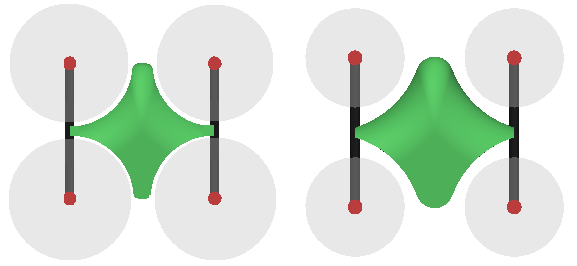
- Morphology finalization — solving for the physical design that satisfies the optimized Talent metrics.
The collective search behavior itself is driven by Bayes-Swarm, a batch Bayesian search algorithm developed in earlier work by this group, which the UAV team uses to decide where to look next given what’s been observed so far.
Case study: victim search and hazard localization
The framework is applied to co-designing a Blended-Wing-Body quadcopter for teams that localize signal sources — directly relevant to victim search after a disaster or hazard localization in an unsafe area — benchmarked against a baseline design modeled on a popular F-450 quadcopter frame. Across a variety of signal environments and team sizes ranging from 6 to 15 UAVs, the co-designed UAV raises the mission success rate from 75.8% (baseline) to 92.6% — at the cost of a somewhat longer average search time (2,764s vs. 2,197s), a deliberate trade-off since success rate was weighted as the priority.
The computing-cost payoff is the more striking number: the five talent-exploration trials, the Bayesian optimization of search behavior, and morphology finalization together took just over 4 hours of total computing time. A fully-nested co-design search, solving the same problem without the Talent-metric decomposition, is estimated at 14.6 days — roughly two orders of magnitude more expensive for a comparable result.
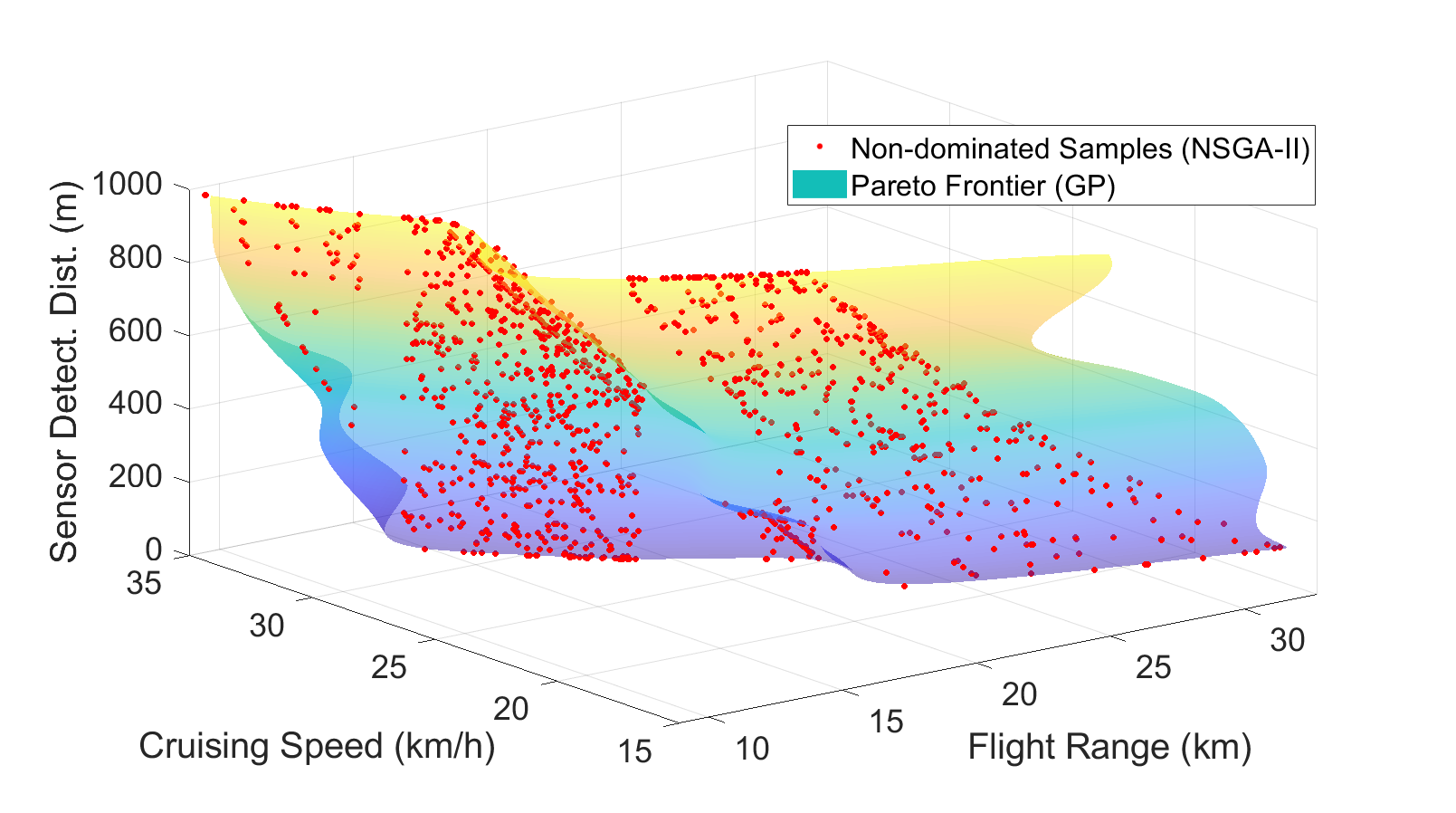
The Pareto frontier above — cruising speed, flight range, and sensor detection distance traded off against each other — is exactly the Talent trade-off space stage 2 explores, here fit with a Gaussian Process surrogate over more than 1,300 non-dominated design candidates.
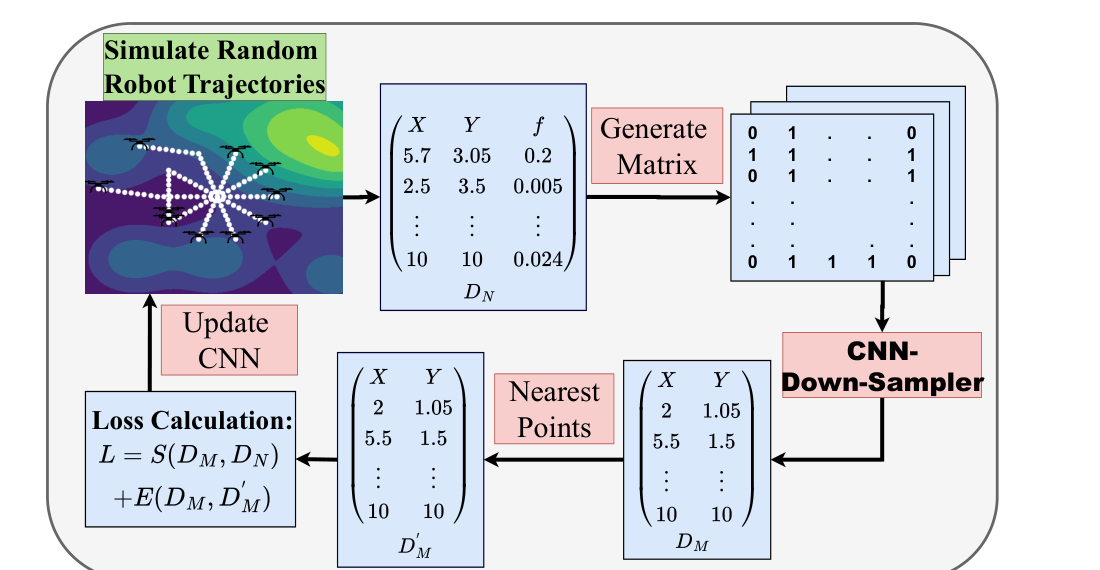
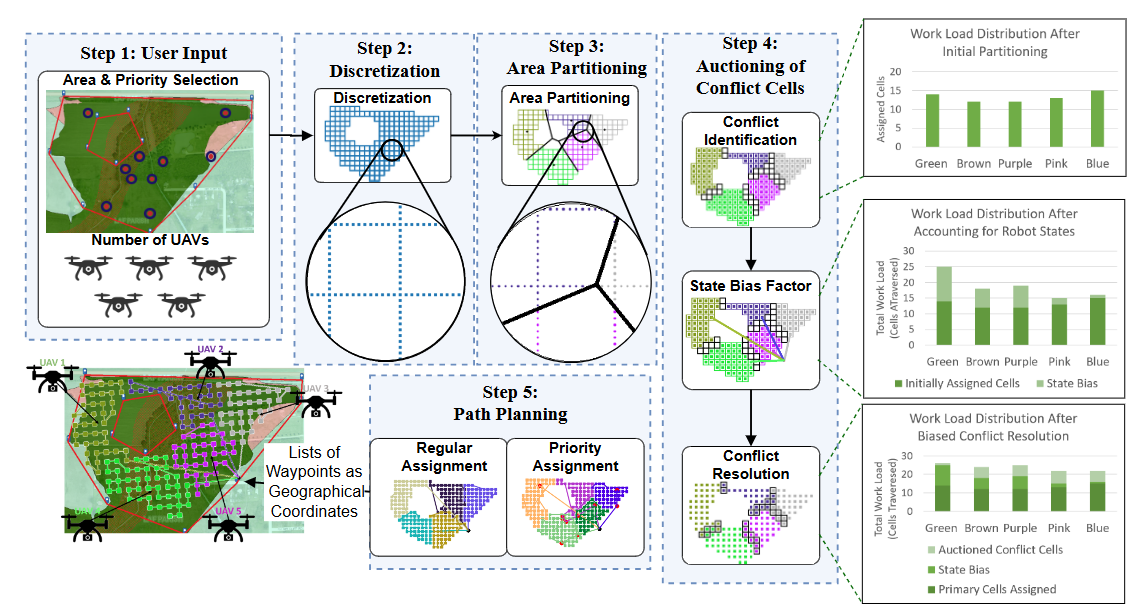
A follow-up paper, "Learning-Based Real-Time Down-Sampling for Scalable Decentralized Decision-Making in Bayes-Swarm Search" (JCISE 2025), tackles the scalability side of this same Bayes-Swarm search process directly, learning to down-sample decision-making so it stays real-time as swarm size grows. A related paper, "Efficient Planning for Scalable and Load-Balanced Area Coverage by Multiple Unmanned Aerial Vehicles" (JCISE 2026), tackles load-balanced coverage planning for the same kind of UAV search team.
Why this matters
Search-and-rescue and hazard-localization missions are exactly the kind of application where getting the hardware/behavior combination right has real consequences — a UAV team with the wrong sensing range or the wrong search strategy for its morphology can miss a signal source it was otherwise capable of finding. This paper is early evidence that concurrent design, done efficiently, produces measurably better-performing teams than the sequential design process that’s still the default in most multi-robot system development — at a computing cost two orders of magnitude lower than the fully-nested alternative.
- What is Bayes-Swarm?
- Bayes-Swarm is a batch Bayesian search algorithm used to drive collective search behavior in a UAV swarm, deciding where team members should search next based on prior observations.
- What is Talent Pareto exploration?
- It's a multi-objective optimization step that maps out the best achievable trade-offs between morphology-driven capability metrics (Talents), used to make joint morphology/behavior co-design computationally tractable.