The problem: swarms are commanded by people, and people are hard to study
Most of the excitement around swarm robotics is about the robots — but in almost every realistic humanitarian or commercial deployment, a swarm is commanded by a human operator, not left fully autonomous. That means the success of a swarm mission depends as much on human-swarm interaction (HSI) — how well the interface conveys swarm state, how well the operator’s commands get executed, how much the operator trusts the swarm — as it does on the swarm’s own algorithms.
Studying HSI properly means being able to vary things like swarm size, how compliant the swarm is with commands, and how much feedback the swarm gives back to the operator, and then measuring how a human’s cognitive state — trust, workload, attention — responds to those changes. Doing that in the real world, with real robots, at meaningful swarm sizes, is expensive and slow. There has been a real lack of virtual environments built specifically to support this kind of study, especially across a range of operationally-relevant contexts rather than one fixed scenario.
The approach: a simulation environment built for cognition, not just control
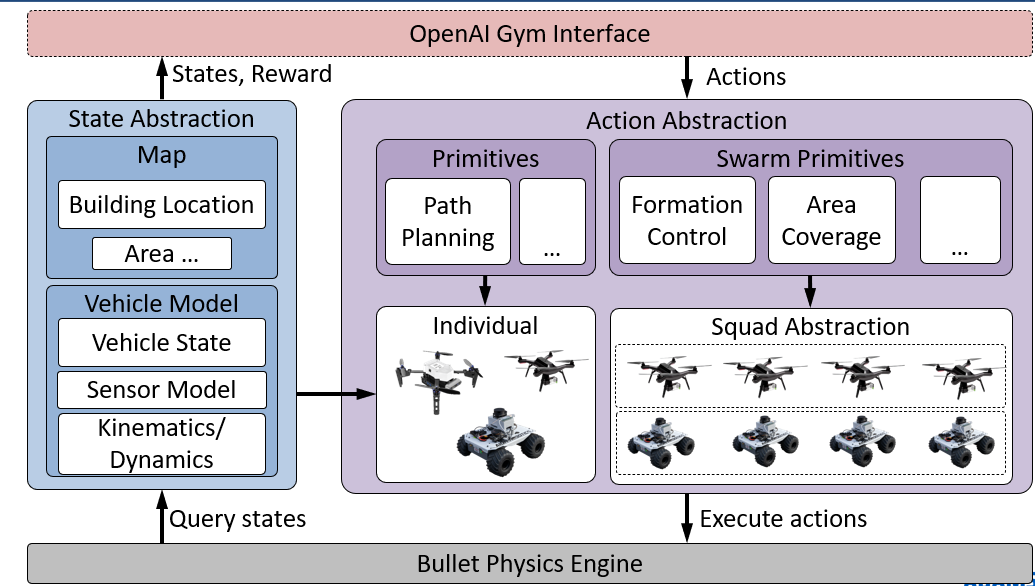
Building on earlier swarm-simulation and computer-game-based HSI work, this paper develops a virtual environment purpose-built to study HSI under varying swarm size, swarm compliance, and swarm-to-human feedback — and to inform the design of a matching physical experimentation environment for evaluating human cognitive models.
The environment includes:
- Medium-fidelity simulation of large teams of small aerial and ground vehicles, built on the PyBullet physics engine — fast enough to run many trials, faithful enough that operator behavior transfers meaningfully.
- A graphical interface for the human operator to issue commands to the swarm and receive feedback — including explicit feedback when the swarm doesn’t comply with a command, which is itself an important condition to study.
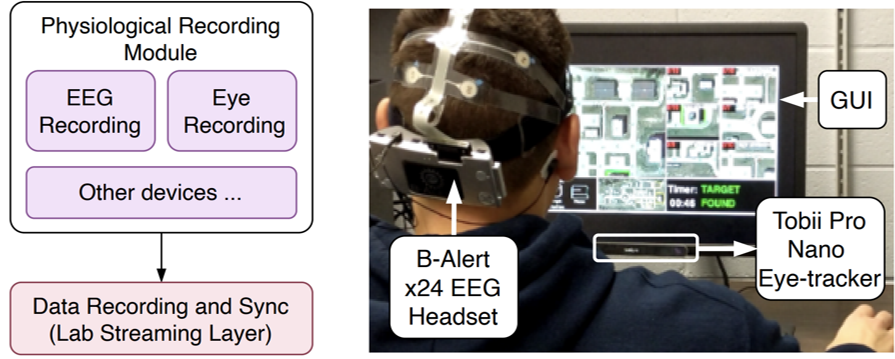
- A lab-streaming layer that synchronizes physiological data — brain activity, eye gaze — with swarm state and human commands in a single timestamped stream, so a researcher can later line up “what the swarm was doing” with “what the operator’s brain and eyes were doing” at the same moment.
The paper also shows how physical-experiment calibration feeds back into simulating physical assets more realistically, closing the loop between virtual study and physical validation rather than treating them as disconnected efforts.
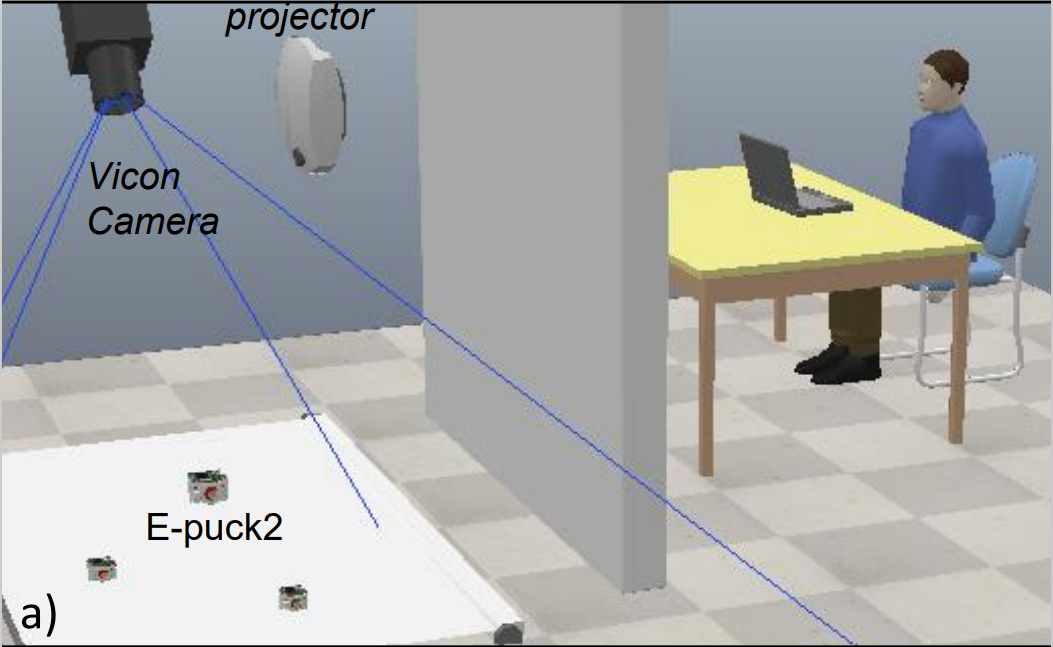
The physical side of this setup uses a Vicon motion-capture room with small ground robots (E-puck2) tracked in real time and projected feedback for the human operator seated at the console.
This environment is part of the broader SHaSTA (open-source Simulator for Human and Swarm Team Applications) effort — the same simulation lineage referenced in this group’s swarm-tactics and swarm-comparison work.
Why this matters
Trust calibration is one of the hardest, least-solved problems in fielding autonomous systems that people actually have to rely on: if an operator trusts a swarm too little, they micromanage it and lose the efficiency swarms are supposed to provide; if they trust it too much, they miss the moments where it actually needs a human override. Getting that calibration right requires being able to measure trust and cognitive load as a function of swarm behavior — which is exactly what this environment is built to make possible at scale, before committing to expensive physical trials.
- What is human-swarm interaction (HSI)?
- Human-swarm interaction is the study of how a human operator commands and cooperates with a robot swarm — including interface design, trust calibration, and how swarm behavior (size, compliance, feedback) affects operator cognition and performance.
- What is SHaSTA?
- SHaSTA (Simulator for Human and Swarm Team Applications) is an open-source simulation environment for studying human-swarm interaction, combining swarm simulation with interfaces and instrumentation for measuring human operator state.