🏆 Best Paper Award — IEEE MRS 2021 (single-track, ~18% acceptance rate)
The problem: swarm missions need more than one primitive
Real-world swarm robotic missions are never just one thing. A mission might need task allocation (who does what), path planning (how do they get there), formation control (how do they move as a group), and a mission-specific objective like target search or area coverage — all composed together, in response to an environment that may be actively working against the swarm (an adversarial environment). Today, that composition is mostly done by hand, by teams of robotics experts who design the mission logic primitive by primitive.
Prior automated approaches to learning swarm behavior have mostly targeted individual primitives in isolation — learn a task-allocation policy here, a formation-control policy there. Very little work had tackled learning complete mission tactics that compose those primitives into something that actually accomplishes a mission end-to-end.
The approach: encoding a swarm as something a neural network can learn from
The central challenge in learning full swarm tactics is representation: how do you encode a swarm of dozens of robots, moving through a complex environment, into a form a neural network can actually learn a useful policy over — especially given how computationally expensive it is to simulate swarm missions at this scale in the first place?
This paper’s answer combines three ideas:
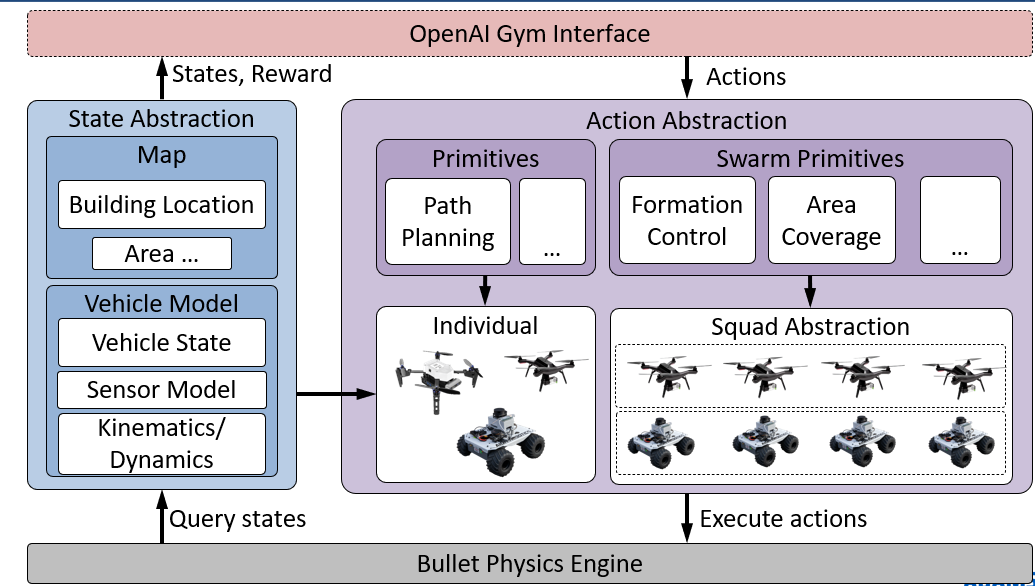
- Map-to-graph abstraction — converting the physical environment into a graph representation that captures the structure relevant to the mission (which areas connect to which, where points of interest are).
- Input/output encoding via Pareto filtering and clustering — using Pareto filtering of points of interest and clustering of robots to compress a large, variable-size swarm-and-environment state into something a fixed-architecture network can consume, without losing the information that matters for tactical decisions.
- Learning via neuroevolution and policy-gradient methods — training the tactical policy with a combination of neuroevolution (evolving network parameters) and traditional policy-gradient reinforcement learning, rather than relying on either alone.
The paper argues, and demonstrates, that this specific combination is what makes learning tractable at all — skip any one piece, and either the representation doesn’t scale to real swarm sizes, or the learning method doesn’t converge on a workable tactical policy.
Results: up to 60 robots, and it generalizes
The learned tactics are demonstrated on missions with up to 60 robots — a swarm size where hand-designed mission logic starts to become genuinely difficult to manage. Just as importantly, training and testing performance statistics closely match each other, which is the paper’s evidence that the learned tactics generalize rather than overfitting to the specific scenarios seen during training.
This paper went on to win the Best Paper Award at IEEE MRS 2021, a single-track venue with roughly an 18% acceptance rate.
Why this matters
Swarm robotics has a long history of learning individual behaviors well — flocking, coverage, simple task allocation — but real missions need those behaviors composed into a coherent tactical response, often under adversarial conditions where the environment is actively working against the swarm (search-and-rescue with hazards, contested environments, disaster response with active hazards). This paper is early evidence that composed, learned tactics can scale to swarm sizes and mission complexity that hand-designed logic struggles with.
- How many robots does this swarm-tactics approach scale to?
- The paper demonstrates successful mission completion with swarms of up to 60 robots, with training and testing performance closely matching — evidence the learned tactics generalize rather than overfitting to specific training scenarios.