The problem: orbit is getting crowded, and debris tumbles unpredictably
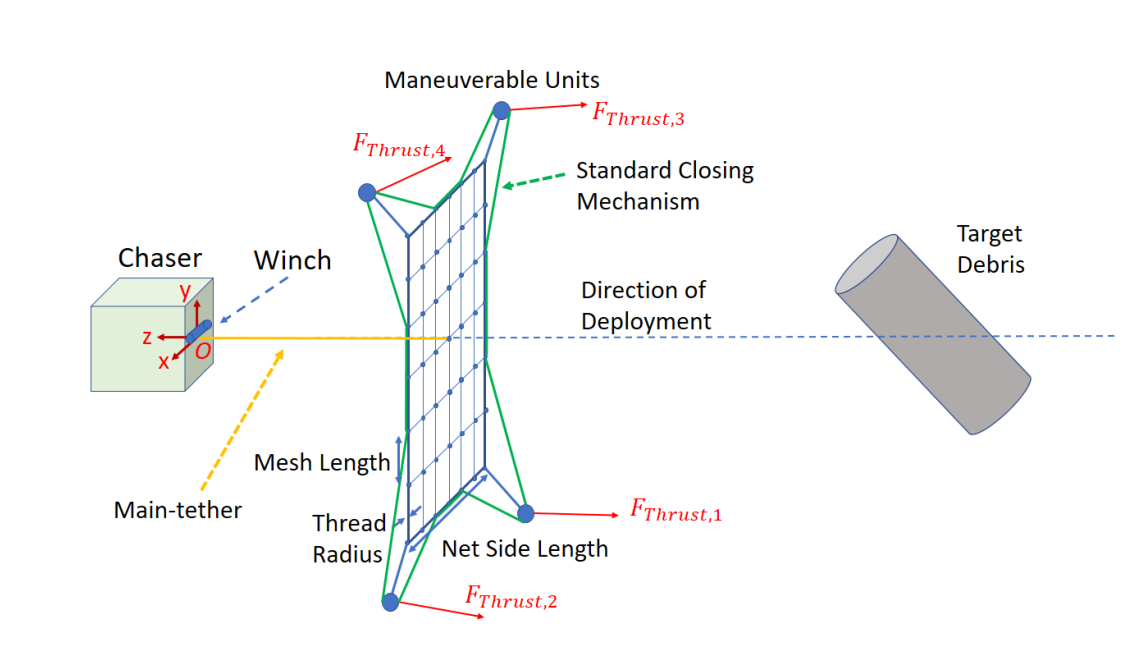
Earth’s orbit is increasingly cluttered with debris — dead satellites, spent rocket stages, fragments from past collisions — that threatens the safety of every active spacecraft sharing that space. An active tether-net system is one of the more promising proposed solutions: a small autonomous chaser spacecraft launches a flexible net with maneuverable corner nodes, which spreads out, envelops the debris, and closes around it for controlled deorbiting or disposal.
The hard part is that real debris doesn’t sit still and wait to be captured. It tumbles, often about multiple axes at once, at rates that vary from object to object. Combined with the sensing and actuation uncertainty inherent to any spacecraft system, that means a net-launch and control strategy tuned for one tumbling scenario can fail badly on the next — autonomous capture needs a strategy that generalizes across debris behavior, not one hand-tuned to a single case.
The approach: four microsatellites, one learned policy
This paper’s design departs from a single rigid net structure and instead uses a decentralized actuation system: four microsatellites, each equipped with cold-gas thrusters, serve as the net’s four corner nodes. Because each corner node can independently fire its own thrusters, the net’s shape and flight path can be actively corrected after launch, as it closes in on the tumbling debris — rather than relying entirely on the net’s initial launch trajectory being right.
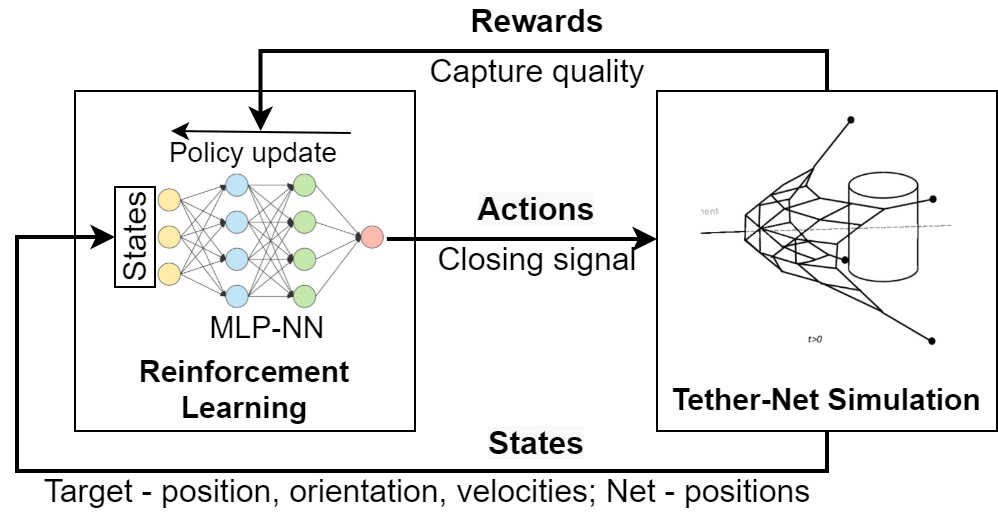
Controlling four independently-actuated corner nodes in coordination is itself a hard control problem, so the paper trains a reinforcement learning policy — using proximal policy optimization (PPO) — against a dynamics simulation of the net and microsatellites built in Vortex Studio, a physics engine suited to this kind of multi-body contact-and-tether dynamics. Each simulated capture attempt is scored on a capture-quality metric, which becomes the reward signal driving training.
Results: fuel-efficient trajectories, generalizable capture
The learned policy finds corner-node trajectories that are simultaneously fuel-efficient and reliable at achieving the target capture quality — importantly, across a range of debris tumbling scenarios rather than one fixed case. That generalization is the paper’s central claim: rather than re-deriving an optimal trajectory for every possible debris behavior (which reliability-based optimization approaches must effectively do), the learned policy adapts its corner-node actuation to the specific tumbling behavior it observes at capture time.
Why this matters
Active debris removal is moving from a research curiosity to an operational necessity as low-Earth orbit gets more congested and collision risk compounds — a single collision can create thousands of new debris fragments, each of which is itself a future collision risk. A capture system that has to be re-engineered or re-tuned for every new debris object isn’t viable at the scale removal will eventually need to happen at; a decentralized, learned control approach that generalizes across tumbling behaviors is a meaningfully more scalable answer.
- What is a tether-net system for space debris capture?
- A tether-net system is a flexible net with maneuverable corner nodes, launched from a small chaser spacecraft, designed to envelop and capture space debris for controlled disposal or deorbiting.