The problem: reliability-based design doesn’t generalize
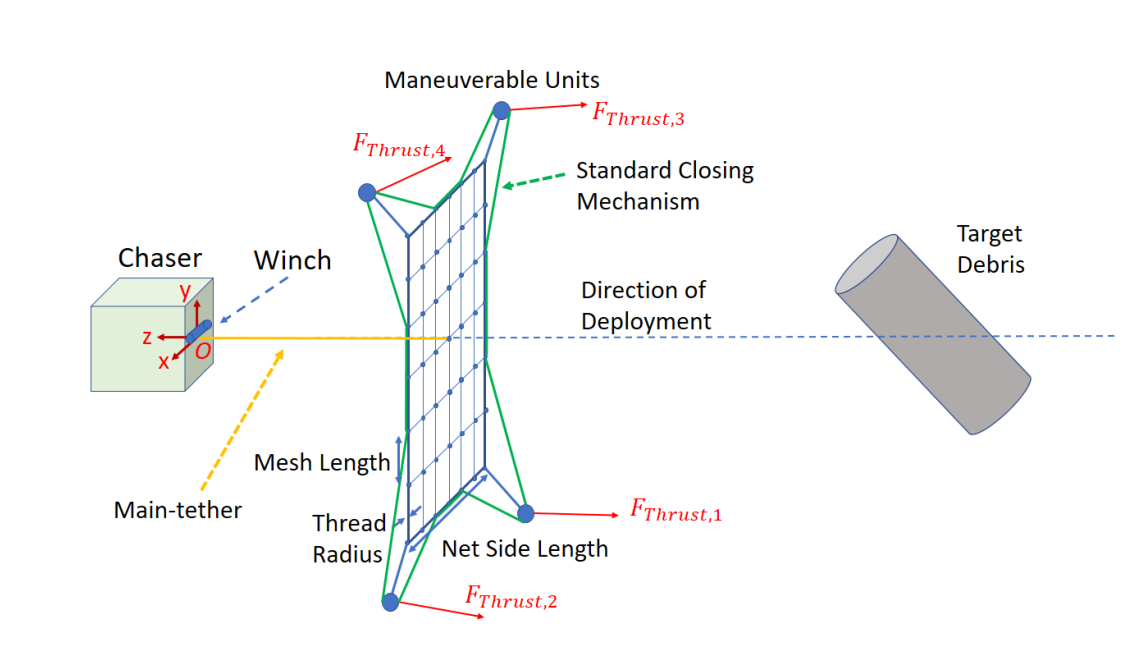
A tether-net launched from a chaser spacecraft is a promising way to capture and dispose of large orbital debris — the idea explored further, with a decentralized four-satellite actuation design, in this group’s later corner-node trajectory work. But before that decentralized design, the more basic question was: how do you decide when to trigger net closure, given that the whole system is subject to sensing and actuation uncertainty?
The traditional answer is reliability-based optimization: model the uncertainty, and optimize a control action for a specific launch scenario and target state. That works, but it’s computationally expensive to redo for every new scenario, and it doesn’t generalize — a control action tuned for one launch geometry and one target motion doesn’t necessarily transfer to another.
The approach: learning net-closing timing with PPO
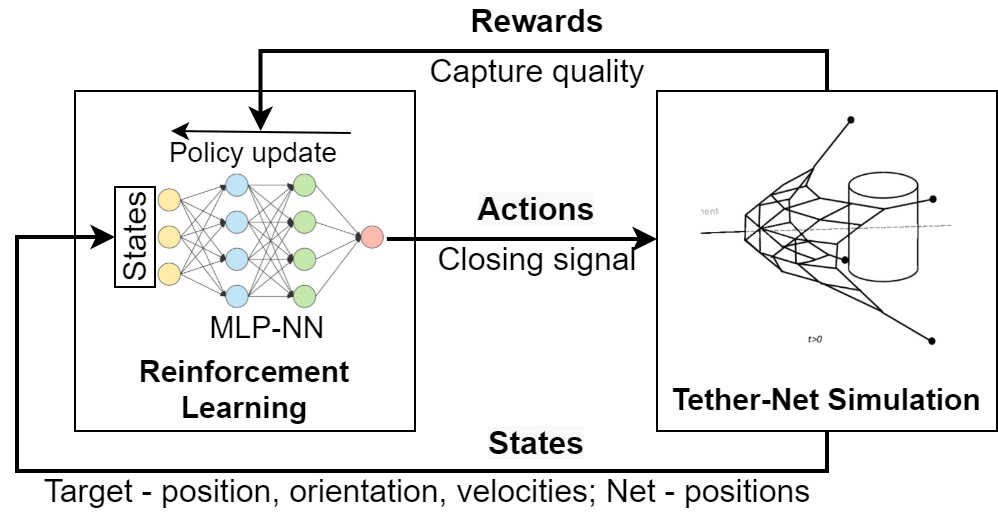
Instead of re-solving a reliability-based optimization for every scenario, this paper trains a reinforcement learning policy — using proximal policy optimization (PPO2) — that learns the general relationship between the state of the moving net and target, and the right moment to trigger net closure.
The RL framework integrates directly with a net dynamics simulation, which plays out episodes of net-based target capture and produces a capture-quality index for each episode — the reward signal that shapes the learned policy. Critically, the simulation includes a stochastic state-transition model, deliberately injecting synthetic uncertainty in state estimation and launch actuation, so the policy learns to handle imperfect information rather than assuming it knows the exact state of the net and target at all times.
Results: near-optimal performance without per-scenario tuning
Beyond steady reward improvement over the course of training, the key result is that the trained policy’s capture performance — evaluated across a wide range of launch and target scenarios — comes close to what reliability-based optimization achieves when it’s tuned individually to each scenario. In other words, one learned policy approaches the performance of many separately-optimized, scenario-specific controllers, without needing to know in advance which scenario it will face.
Why this matters
This is the generalization result that makes the later decentralized, multi-microsatellite tether-net design practical: a control approach that has to be re-derived for every debris tumbling pattern doesn’t scale to a world with many different debris objects in many different states. Learning a single policy that performs well across scenarios — rather than optimizing a new one for every case — is what turns tether-net capture from a research demonstration into something that could plausibly be operationalized.
- What is a capture-quality index?
- It's the metric used to score how well a simulated tether-net capture episode performed, serving as the reward signal that guides reinforcement learning training in this work.