The problem: morphology and behavior are usually designed separately
Interesting, efficient collective behavior in a multi-robot or swarm system emerges from the individual behavior of the robots that make it up. But that behavior doesn’t exist in a vacuum — it’s shaped and constrained by each robot’s morphology: its physical design, sensors, actuators, and payload. A quadrotor built for speed behaves differently than one built for endurance, no matter how good its control policy is.
The standard engineering practice is to design morphology and behavior sequentially: pick a hardware design first (often driven by cost, manufacturability, or intuition), then design or learn a behavior policy for that fixed hardware. This is the easier problem to solve, but it leaves performance on the table, because it never asks the harder question — what if a different morphology, paired with a different behavior, would do the job better as a team?
This paper’s premise is that the full potential of a multi-robot system can only be realized by optimizing morphology and behavior concurrently, with feedback about collective (team-level) performance driving both design choices at once — a problem generally known as co-design.
Why concurrent co-design is hard
Naively, co-design means nesting two expensive searches inside each other: for every candidate morphology, you’d need to fully train a behavior policy before you know how good that morphology actually is. For a multi-robot task allocation (MRTA) problem — where a team of robots has to decide who does what, where, and when — training even one policy is already computationally expensive. Nesting that inside a morphology search multiplies the cost to the point of being intractable for any realistic design space.
The approach: decomposing co-design with “Talent” metrics
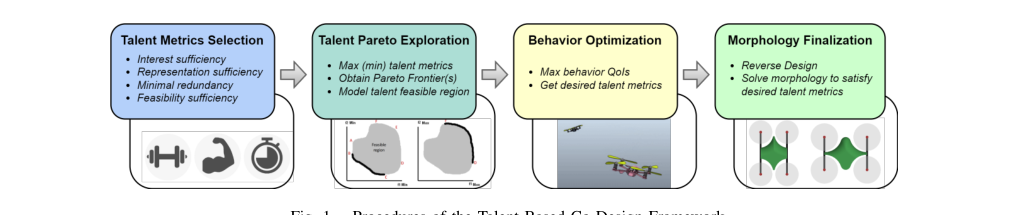
This paper’s core contribution is a way to decompose the co-design problem so it no longer needs full nested optimization. The method introduces Talent metrics — morphology-dependent measures of what a robot is capable of (e.g., speed, range, sensing radius) that summarize how a physical design translates into task-relevant capability, without requiring a full behavior policy to be trained first.
The pipeline has two main stages:
- Talent Pareto exploration — a multi-objective optimization over the morphology design space, identifying the Pareto front of Talent trade-offs (for example, the best achievable combinations of speed vs. range for a given airframe budget).
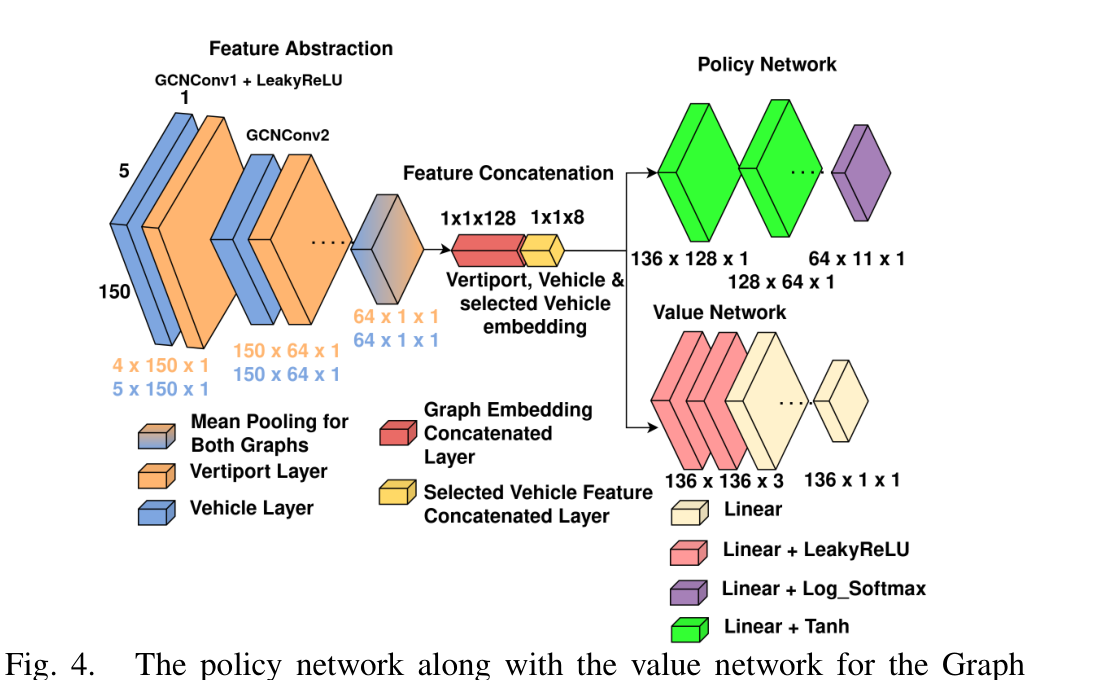
- Joint policy and Talent-selection learning — using graph reinforcement learning to simultaneously learn (a) which point on the Talent Pareto front to select, and (b) the individual robot policy that, combined with that Talent choice, maximizes team-level MRTA performance.
Because the graph-based policy learns to allocate tasks across a team represented as a graph (robots and tasks as nodes, feasible assignments as edges), it naturally generalizes across different team sizes and problem instances — a property standard fixed-input neural networks struggle with.
Case study: multi-UAV flood response
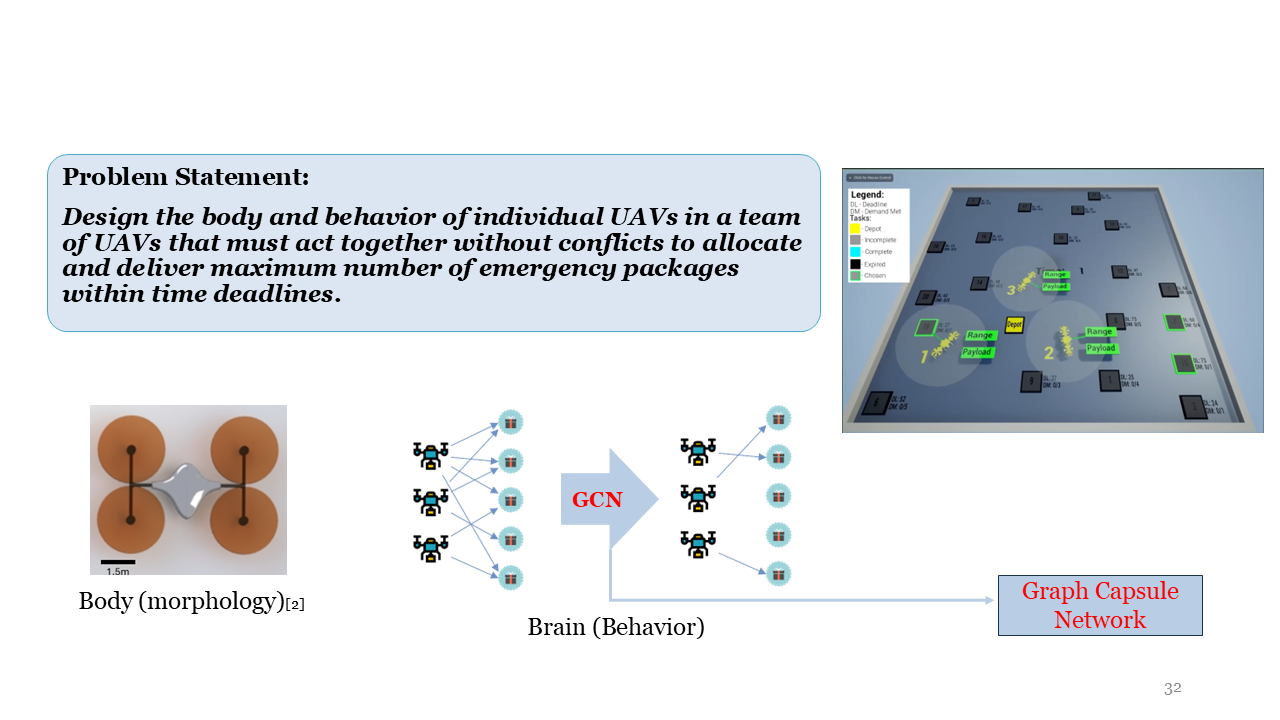
The framework is demonstrated on a multi-UAV flood-response scenario, where a team of aerial robots must allocate themselves to time-critical tasks (e.g., surveying or resupply points) across a disaster area. The co-designed systems — where morphology and behavior were optimized together — outperform sequential design baselines, where morphology was fixed before behavior was learned.
Just as notably, the paper finds that the learned behavior itself looks different depending on whether the morphology was co-designed for a single robot or for a multi-robot team performing the same operation — evidence that team-level dynamics genuinely change what the “right” morphology and behavior look like, and that treating them separately misses that interaction entirely.
A companion paper, "Towards Physically Talented Aerial Robots with Tactically Smart Swarm Behavior thereof: An Efficient Co-design Approach" (ASME IDETC 2024), extends this Talent-based framework specifically to aerial swarm behavior design.
Why this matters
Most robotics research treats hardware and software as separate design tracks — mechanical engineers pick the airframe, then a controls or ML team writes the policy for it. This paper’s Talent-metric decomposition is a step toward making joint hardware/behavior optimization computationally practical for real multi-robot task allocation problems, not just small toy examples — relevant to any application where the team of robots, not a single robot, is the unit of design: disaster response, agriculture, warehouse logistics, and search-and-rescue among them.
- What is a "Talent" metric?
- A Talent metric is a morphology-dependent capability measure (like speed or sensing range) used in this paper to summarize what a given physical robot design is capable of, without needing to fully train a behavior policy for it first — making joint morphology/behavior search computationally tractable.